
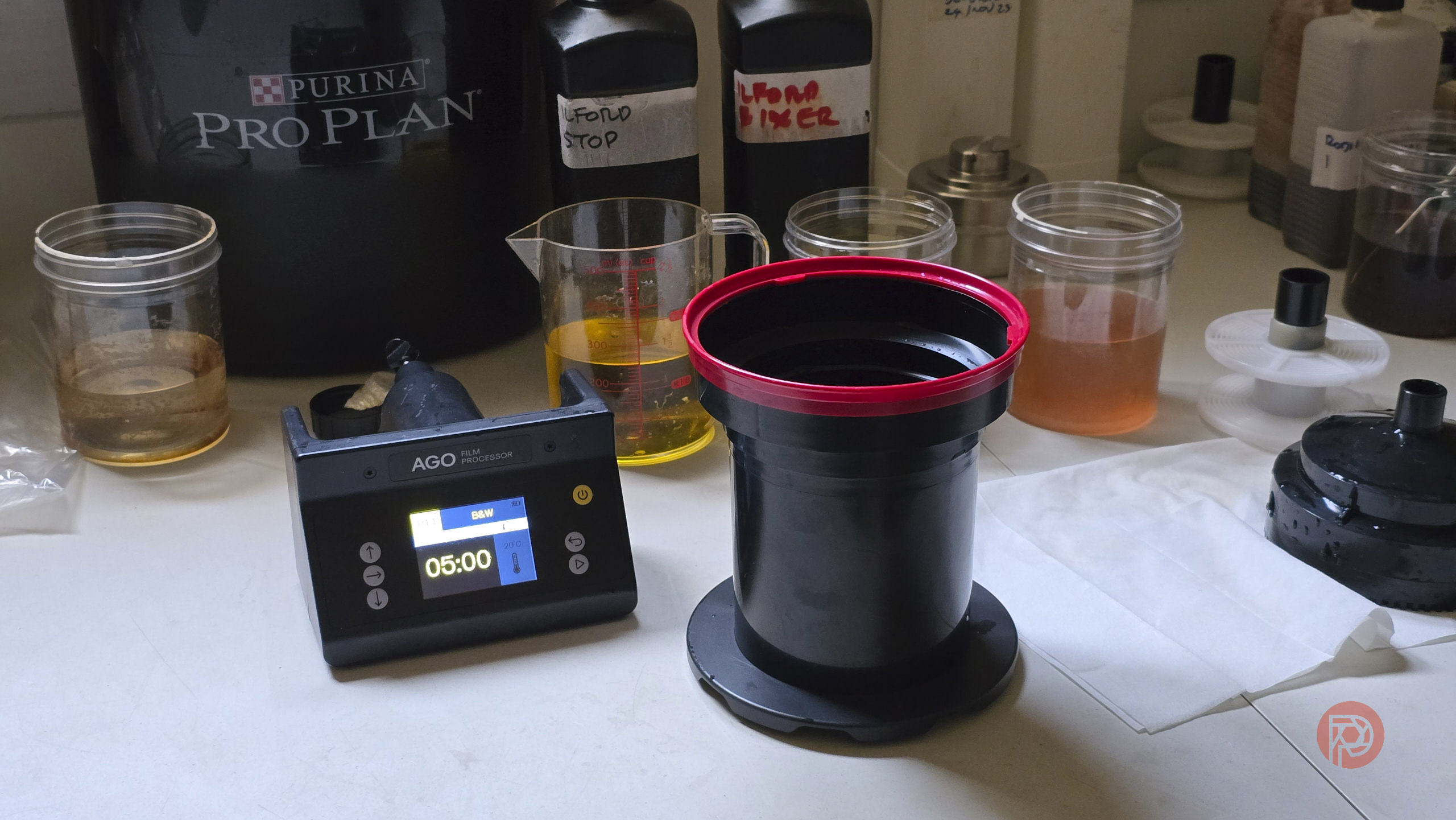
Film photography has become popular again in recent years, but developing it at home can still be daunting. Storing chemicals at the right temperature, remembering agitation cycles, and watching timers closely can be painfully time-consuming. It’s easy to make mistakes when everything has to be done manually. The AGO Film Processor was created to make this process simpler, more reliable, and far more accurate and cost-effective. Being compact, battery-powered, and programmable, it automates repetitive tasks while allowing you to control your workflow. Whether you are using black and white film or handling complex color processes like E-6, it promises consistent results without the typical darkroom routine stress.
The Big Picture: AGO Film Processor Conclusions
For years, developing film at home has combined art and science with a bit of juggling. You’d have to closely monitor temperatures, agitate tanks, and time each step carefully to the T. It often felt like an extra pair of hands would be needed just to process a roll of film properly. The AGO Film Processor, created by Vintage Visual, addresses this issue. It’s a compact, battery-powered, programmable device that takes on the mechanical tasks of film development so you can concentrate on photography.

What makes this unit unique is its blend of automation and precision. It uses Active Time Compensation to adjust the development process in real time as your chemicals cool or warm. Yup, that’s correct – it adjusts the time needed for each step in real time, based on the exact temperature. Instead of hovering with a thermometer and calculator, the AGO handles the calculations for you. The other star of the show – rotary agitation. This not only ensures consistent development but also reduces chemical usage by up to 60%. That’s a significant savings if you develop film regularly, especially color film that usually requires more costly kits. Film photography prices have been on the rise for some years now, so any kind of savings in this genre is very welcome

In the past few weeks, I have developed both black-and-white film and color reversal (E-6) using the AGO. The results were not only consistent but also surprisingly liberating. I didn’t feel tied to the tank like I used to in the past. This small device makes film development more predictable, efficient, and portable. It’s not perfect, but I think the next iteration will be
- Automated temperature compensation ensures the development time remains accurate always
- The rotary agitation system ensures even development while using up to 60% less chemicals
- Pre-set recipes for B&W, C-41, E-6, and others, along with Wi-Fi support for your own custom workflows. This is really important what with all the various hacked and restored film stock there is out there today, which don’t really follow standard processing times
- Rechargeable power, so you don’t need to be tied to a power outlet
- 35 and 120 film support, as long as you use the right Paterson SS4 tanks
I only wish the lock mechanism on the unit had a more satisfying and audible click. There were times when I didn’t realise that the Paterson tank wasn’t firmly locked, which led to some leakage. Aside from this one little niggle, everything else is really on the money with the AGO Film Processor. It’s worth the price as it’s saving you a lot in the long run, and it deserves five stars and our Editor’s Choice Award for this.

Experience

The first thing that struck me about the AGO Film Processor was how much it changed the pace of developing film at home. Typically, film development feels like a juggling act. You hold your thermometer in one hand, your timer in the other, and your tank somewhere in between. All this while trying not to lose track of the careful order of steps. If you miss an agitation cycle by a few seconds, you end up with uneven negatives, as I’ve managed to do countless times in the not-so-recent past. With the AGO, I finally felt like I could let go of a lot of that anxiety, but of course, only after thoroughly testing it out a few times.
Loading my Paterson tank was the same as before, which is very much appreciated. Vintage Visual could really have had us hooked on this product and forced to buy proprietary tanks (*cough cough* Apple), but they haven’t gone down that route. Once the tank rotated into place, and after I triple checked it, I selected my process from the menu and hit start. That was it. No frantic taps on a stopwatch, no constant inversions. The rotary agitation started immediately, smoothly moving the chemistry inside. The motion was steady and almost soothing, but most importantly, it was consistent. Since the tank does not need to be completely filled, it uses significantly fewer chemicals. That is a small win that most people might overlook at first, but after using a few boxes of C-41 or E-6 kits, the savings start to add up. Especially in countries where chemicals aren’t easily sourced locally,y and we need to import them from abroad at high shipping costs.

Another thing that surprised me was how modern it felt. The AGO has preloaded recipes for black and white, C-41, and E-6, but you can adjust or create your own workflows using Wi-Fi. It reminded me of loading custom presets into Lightroom, but this was for film development. I tried it by changing development times for a roll of black and white film, and the adjustments synced instantly from my laptop. For once, “programmable” did not feel like marketing hype – it felt necessary here, and it often worked better than I expected.

The device itself feels compact and portable, making it suitable for real-world use. My favorite darkroom is in my dear friend Don Surendra’s home, a place where I have pretty much done most of my developing these last few years. We set the AGO up on it for the first run, and what struck us right away was how intuitive it was to use the unit. The menu wasn’t complicated at all, and the process itself is just a quicker, more cost-effective way of processing for seasoned film developed. No worrying about being electrocuted despite having a motor in there, as the rechargeable battery (which lasts for about five hours) means you could run multiple rolls back to back without worrying about plugging it in. That kind of freedom is rare with anything film-related.

Now, there were occasions when we observed chemical leaking onto the table, which goes back to the tank lock issue. It would appear that this has been a commonly reported problem, as there’s even a section on their website addressing this. I learned about this link when I contacted Joonas, the brainchild behind this product. He responded quickly and told me how to address the matter.

Over the weeks, I noticed how the AGO changed the feel of my workflow. For the most part, Don and I didn’t fret much during the development. We spent our time chatting over freshly brewed tea and catching up on our recent photography projects, occasionally glancing at the timer to see if the timing on the LCD was somewhat matching the meticulously drafted timing charts that Don has in his photography room. The unit would beep whenever it needed us to intervene, and we would step in for the next stage before letting it do its thing again. I definitely don’t miss the stress that usually comes with developing – the frequent second-guessing and strictly adhering to timelines.
Of course, it is not magic. You still have to measure and pour your chemicals, keep your workspace clean, and rinse the film properly. Still, having the AGO take care of the repetitive parts of the process made the whole experience smoother. Thanks to this, developing film is starting to feel less like a task and greatly helps save time and money
Results

The true test of any film processor lies in the negatives and slides it produces. During the first run with the AGO, we attempted to develop a roll of black and white 120 film. From the moment the reel came out of the tank, I noticed a difference. The development was smooth, even, and free from the small inconsistencies that can occur with manual processing. Shadows had detail, highlights weren’t blown out, and the grain appeared clean and natural. It felt like the kind of result you usually get only when everything goes perfectly. Here, it happened on the first try without me worrying about timers and thermometers.

We then decided to move on to something much less forgiving: E-6 color reversal film. If you’ve tried to process slide film at home, you very well know the pressures of keeping the developer at the right temperature. Even small fluctuations can affect the colors or make the images look dull. As the developer cooled slightly during the process, the AGO’s Active Time Compensation feature quietly extended the duration, making minimal increments in real time. Honestly, it was like watching a self-aware computer perform micro calculations in real time, and to be fair, it was one. The result was a set of vibrant, accurate slides that appeared as if they had come from a professional lab. This was an experiment on many fronts as the stock itself was a non-traditional roll from the folks at Elevan Chan. The color balance was perfect, and the density across the frames was consistent. When we held up those transparencies to the window, what we saw confirmed that the AGO was delivering exactly what it promised.
I also developed a roll of C-41 color negative film to check for consistency across different formats. I quite liked the results here too. Skin tones looked natural, and there were not too many noticeable signs of overdevelopment or streaking. The consistency between results was what was most impressive. With the AGO, each roll appeared to go through the same process, and that’s pretty much what you want in terms of results when you’re already spending so much on the materials. You don’t feel like you’re gambling with each roll.

As long as the tank is locked on correctly, you can rest easy knowing that the results will be in tune with your expectations, provided the right balance of chemicals is chosen. AGO gives you the peace of mind you need when developing analog film in a digital world.
