
Spread the love
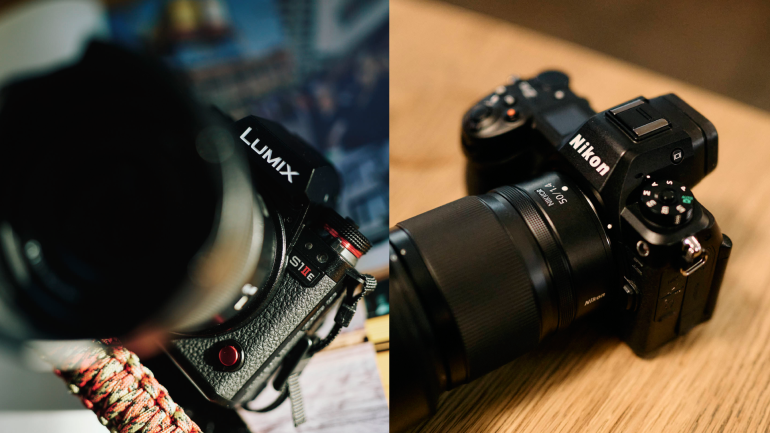
When it comes to photography, one often looks for the best camera for themselves. While there are multiple full-frame cameras to choose from, one usually looks at options such as Canon and Sony. However, today we have two new offerings that will certainly help you to make an informed choice: Panasonic and Nikon. If you are looking for a new camera, see which of the two can be of help to you.
Autofocus
The Panasonic S1 IIE is faster than the Fujifilm X-H2. In our long-term review, we noticed how the camera can auto-focus on people of color, even in low light. There is also a human sports mode, but that works a bit off. Otherwise, the camera is perfect in many ways, and it can track subjects with ease. It is one of the cameras for which we very rarely receive complaints.

The Nikon Z6 III excels in two areas: it can track subjects effectively in low light, and it performs well with scene modes. An example is tracking a dog, which we saw during our test shoot. However, while it is good at certain things, it lacks in others. For instance, stills. The Z6 III lagged behind higher-end cameras from the company. If you are an option for it, then you can work well in good and moderate light.
Specs
– The Panasonic S1II E has 779 autofocus points, and includes Human, Animal, Car, Motorcycle/Bike, Train, and Airplane detection
– Nikon Z6 III has 493 focus points, and it also has Animal, People, Vehicle, and Airplane, and auto subject detection
Image Quality and High ISO

The Panasonic S1 IIE has some truly exceptional RAW file versatility. As long as you shoot with sensibility, you will get the desired images. Even if you overexpose the images, you can save the photographs in post-processing. The high ISO output is also clean, and you can mask the grain with film LUTs. This device is best used for JPEGs, which are far superior to Fujifilm cameras.

The Nikon Z6 III also offers great image quality. The camera can reproduce images seen on other Nikon cameras, and that is ideal given its price point. There is also good low-light image quality, but the latter is not exceptional, per se. If you are a beginner, then the Z6 III can be a great deal for you, as you get a good reproduction of details.
Specs:
– The S1II E has ISO up to 204,800, and a burst rate of 30fps.
– Nikon Z6 III has an ISO of up to 204,800, and a continuous shooting speed of 20fps with RAW. If you want more, you get 60fps, albeit only in JPEG, and 120fps, with a 1.5x crop.
Build/Ergonomics

The S1IIE is similar to the S1II and the S1RII in terms of design, with the changes visible on the inside. The camera is also weather-resistant, the shutter closes over the sensor, and the button layouts are well-designed. The LCD can be used at any time, and the camera holds up in any situation. Furthermore, you can shoot for hours on a single battery, and it can survive. Similarly, the menu system is great and easy to navigate.

The Z6 III incorporates features from both the Z6 and the Z8. However, it is not as tall as the Z8. The device feels exactly like a Nikon camera and is suitable for individuals who prefer a smaller alternative to the Z8. If you are a fan of a DSLR body, then the Z6 III can be of help. There is no shutter to cover the sensor, so you must be careful when changing lenses. The viewfinder is bright, and the camera can read out faster.
Specs:
– The S1IIE features a 1,840k-dot LCD, and features a 5,760k-dot OLED LCD, and a 5-axis image stabiliser
– Nikon Z6 III has 5,760,000-dot EVF, 3.2-inch 2,100,000-dot LCD, and 5-axis image stabilisation
Conclusion
The Z6 II costs about $2349, while the S1IIE is priced at $2492, making them close competitors in the price segment. Then it boils down to the performance and the features the cameras can offer. From whatever we have seen, the S1IIE seems like a better bargain for its price. But if you already have a Nikon model and want to get a second one, then the Z6 III is ideal for you.
